
The reciprocal relationship between the VC firm, its funds and portfolio companies
Drawing on our work with venture investors and startups as well as insights from books and research on venture investing, this article considers how a VC firm formulates its investment approach, manages successive funds and assists portfolio companies with growth and financing. We hope to give emerging VC firms and founders a better appreciation of the decisions and expectations on both sides. We welcome the experiences, questions and differing views of practitioners, founders, VCs and other interested readers, whether shared with us on LinkedIn or at transaction@indiacp.com.
The Firm, Its Funds and Its Investments
Even after a decade of developing a company, a venture capital firm may be under pressure to sell its investment at precisely the point when the business begins to gain momentum. Closure of the first fund may be imminent, the second may require reserves to support existing investments, and fundraising for a third may already occupy the partners. The founders may see another phase of growth for the company; the first fund’s investors expect distributions; the VC firm seeks a track record of realized returns to convince investors to support it once more. The challenge is to reconcile objectives that are reasonable for each of the parties.
That tension demonstrates that the lifecycle of a VC firm is not confined to a single fund or investment. The firm builds a thesis, a team and relationships capable of enduring. Investors, the mandate and the agreed duration are specific to each fund. For each portfolio company, the pace of development is governed instead by its products, customers, capital requirements and prospects of a sale or listing.
The significance of this interdependence is not limited to investment timing. A VC firm’s strategy informs its choice of funds to raise and companies to back. The mandate and reserves of each fund, and the proximity of its maturity, shape the support available to those companies. Their growth and eventual realizations determine investor returns and also bear on the firm’s ability to raise a successor fund. The links among the VC firm, Fund and portfolio company extend from sourcing of funds and the terms of investment to governance, follow-on decisions and exits. For new VC firms, an appreciation of those links helps in building sound investment businesses; for founders, it helps identify investors with capabilities and expectations aligned with their plans.
1. Establishing a VC Firm
For a new VC firm, the basis for its existence must be an advantage that is not readily replicable by an established competitor. The partners may know, for instance, how software is purchased by Indian banks, which parts of an industrial supply chain generate unnecessary costs, or which research laboratories develop technology with commercial utility. Such experience must translate into a real advantage, whether in accessing founders earlier, assessing technical or commercial risk with better information, or assisting companies following investment.
Five related questions allow the partners to convert that advantage into an investment thesis:
- Which companies have the potential to grow sufficiently to generate the returns required by the proposed fund?
- At which stage would the firm be better placed than competing investors to assess such companies?
- What level of ownership would warrant the initial cheque and withstand subsequent dilution?
- What amount of follow-on capital must be set aside by the fund to support its strongest investments?
- Which realistic exit routes could convert those ownership stakes into distributions?
These questions determine the appropriate fund size rather than merely follow from it. A seed specialist may discover promising companies with modest cheques, whereas a deep-technology investor may need substantial reserves and years of scientific validation. A firm that raises a large corpus for the prestige of managing one may later find that its preferred transactions absorb too little capital. Moving into larger rounds then changes its competitors, due-diligence demands and risk profile.
Sourcing should put that claimed advantage to work. An established VC firm may attract referrals from founders and co-investors; a new one must often create its own access. A firm specializing in banking software, for example, can speak to procurement heads, map costly implementation problems and identify technical teams working on credible solutions before those teams seek capital. The research gives it two advantages: an early conversation with the founder and a sharper test of whether customers will buy. Proprietary sourcing therefore means earning differentiated access through knowledge and experience, rather than simply collecting more introductions.
Investment judgment also depends on how partners disagree. A partner sponsoring an investment may understand an emerging technology that the wider investment committee considers premature. If the committee rejects every unfamiliar model, the firm may miss the exceptional outcomes its fund requires; if the sponsoring partner’s conviction always prevails, enthusiasm can overwhelm evidence. The firm should specify the assumptions on which an investment depends, invite a serious opposing case and assign responsibility for the final decision. The same discipline matters when a portfolio company later needs additional capital.
When a VC firm raises its first fund, potential investors (who may eventually become limited partners (LPs)), carefully assess the experience and abilities of its founders. They examine the role each partner played in previous investments, how they find promising startups, why they rejected certain investment opportunities, and how they handled investments that did not perform well. First-time firms must demonstrate a repeatable process before they can show a mature record of realized returns. The Bain–IVCA India Venture Capital Report 2026 records approximately US$5.4 billion of VC/growth fundraising in 2025, with established firms attracting much of the capital. An emerging VC firm must therefore demonstrate an investment advantage, rather than offer a familiar investment pitch.
Management fees ordinarily support the VC firm’s investment professionals and operating costs, while carried interest gives its team an agreed share of fund profits under the distribution arrangements. The fund holds the investments for the benefit of its investors; the VC firm’s reputation depends on what those investments become. Beyond providing capital to the potfolio companies, the VC firms may help win customers, recruit leaders, refine strategy, improve financial controls or arrange further financing. Successful portfolio companies strengthen the fund’s reported results, but their growth alone cannot show how much value the VC firm contributed. Realized returns, sound decisions and the quality of support through difficult periods offer a fuller measure of its work.
2. Raising and Running a VC Fund
A fund gives the VC firm’s strategy a defined investment mandate. Category I Venture Capital Funds face a prescribed venture-investment composition test, while Category II AIFs can pursue broader growth strategies subject to their own restrictions.
Portfolio design begins with the financing required to reach an exit. Consider an illustrative INR 200 crore fund: INR 80 crore for twenty initial investments of INR 4 crore each, INR 90 crore in follow-on reserves and INR 30 crore for fees, expenses and contingencies. The fund can pursue several uncertain opportunities, then concentrate reserves in companies that demonstrate the strongest prospects. A concentrated Series A fund would choose fewer initial positions and larger ownership stakes. Each model must leave sufficient capital for the later rounds its portfolio is likely to need, rather than merely for the first cheques it hopes to write.
Suppose an initial investment of INR 4 crore buys 15% of a company’s equity shares. Further financing dilutes that holding to 10% unless the fund commits additional capital to maintain its stake. If a buyer subsequently acquires the company at an aggregate equity value of INR 2,000 crore, the fund’s 10% shareholding could yield INR 200 crore in gross sale proceeds, before applicable transaction costs, taxes and distribution arrangements. At an equity value of INR 500 crore, the same holding could yield INR 50 crore. Supporting the company in later rounds could protect the stake but would consume reserves available to other promising investments. That is why a strong company can still be a poor investment for a particular fund at a particular price.
A fund passes through overlapping periods of investment, realization and residual obligations. It first builds the portfolio and finances selected follow-on rounds; as holdings mature, it pursues strategic sales, secondary transactions or liquidity through the public markets. The remaining period, often called the tail which concerns unsold investments and obligations as the fund approaches closure. A VC firm may sell an early winner while still making new investments or support a company after its scheme’s investment period ends. The agreed investment period and legal tenure therefore matter from the first cheque.
The age of a fund affects what its VC firm can promise a founder. A fund early in its investment period may lead a new round and reserve capital for later financing. An older fund may concentrate on protecting existing holdings or seeking liquidity, even if the VC firm favours a new opportunity. Where the firm manages several funds, each holds separate reserves and follows its own allocation and distribution arrangements. Founders should ask which fund will invest, how much capacity it retains for follow-on rounds and when its investment period ends.
LPs distinguish portfolio value from capital returned. Total value to paid-in capital (TVPI) combines distributions with the estimated value of investments still held. Distributions to paid-in capital (DPI) measures value already distributed against contributed capital; in-kind distributions may also count under the relevant reporting method. Internal rate of return (IRR) reflects the annualized return implied by the amount and timing of contributions, distributions and, where applicable, remaining value. A fund can report strong TVPI while much of its portfolio remains illiquid. When the VC firm raises a successor fund, LPs will examine how much capital the existing fund has actually returned to investors, how its remaining portfolio investments are valued and how much additional funding those portfolio companies may require.
3. Choosing the Right VC for a Startup
As a company matures, the uncertainties surrounding its business change, along with the expectations of potential VC investors. A seed investor may finance an unproven product and capable founding team; an early-stage VC firm may seek evidence of sustained customer demand; a growth investor must examine margins and cash requirements; a later-stage investor will consider governance and a realistic path to liquidity. The question is which risks the particular VC understands and is willing to finance.
The following table outlines the key factors VC firms assess at different stages of a startup’s growth journey and the questions they may ask its founders to test the investment case.
| STAGE | What the VC firm examines | Discussions with the Startup |
| Seed / pre-revenue | Founder insight, technical feasibility, initial evidence of a real user problem | What evidence demonstrates that customers face a genuine problem? What initial tests have validated your proposed solution? |
| Early stage | Repeat use, retention, pricing power, contribution margins | Would demand survive without discounts? Can customers be acquired repeatedly at viable cost? |
| Growth / expansion | Repeatable sales, margins, working capital needs, execution | Will rapid expansion improve profits or multiply losses and funding needs? |
| Later stage | Sustainable financial performance, governance, exit readiness | What evidence supports your financial projections and proposed valuation? What realistic opportunities exist for investors to exit their investment? |
A deep-technology company may need years of experimentation, intellectual-property protection and specialized equipment before its market can be tested. A consumer business may produce quicker demand signals but require careful spending on acquisition, retention and fulfilment. A regulated fintech venture faces licensing, operational and compliance risks that conventional software companies may avoid. Sector specialists may recognize these difficulties earlier, while generalists can bring useful comparisons from other industries. Founders should judge those capabilities against the problem their business actually faces.
Sourcing often begins before a company approaches investors. A research-led VC firm may contact a team before it announces a round; another may learn of the company through a founder, operator or trusted co-investor. Neither introduction guarantees investment. Founders should ask what the firm understands about their market, what support its partners have actually provided to other companies, which fund would invest, what ownership and governance rights it normally seeks, and how much follow-on capital remains available. References from existing portfolio founders can help distinguish genuine operating assistance from an attractive presentation.
Diligence tests why a startup should succeed and what could cause its thesis to fail. A VC firm examines the founder’s insight, the customer’s problem, competing solutions, the addressable market, pricing and the capital required to reach the next decisive milestone. It should also ask whether a well-funded rival could copy it and whether demand would survive the withdrawal of discounts. For an early-stage company, these questions test the team’s capacity to learn; for a mature business, they test the quality of revenue, retention, margins and governance.
A VC firm should ask which customer belief the team has tested, what contrary evidence changed its plan, how it recruits professionals with expertise beyond that of the founders in key business functions and how it spends money when growth disappoints. Some firms favour an unusually ambitious founder who challenges established practice; others demand a management team that has already demonstrated repeatable execution. A founder who understands the investor’s hypothesis can address the underlying concern instead of merely refining the pitch.
Early investors in Twitter recognized the potential of its growing user engagement despite the absence of an established monetization model. Fab.com, by contrast, attracted substantial venture funding following rapid growth in registered users and merchandise sales, but its aggressive expansion and high cash burn ultimately undermined the business. Both experiences challenge mechanical screening: early revenue may reveal little about eventual scale, while impressive growth can conceal fragile economics. A VC firm therefore identifies the uncertainty it is financing, the evidence that could resolve it and the capital needed to test its assumptions.
Even a favourable assessment must satisfy the particular fund’s return requirement. The same company may suit a smaller fund seeking a meaningful but attainable exit and fall outside a larger fund that needs much greater scale. Entry price, expected dilution and the time needed to reach liquidity change the calculation further. A rejection may therefore reflect a mismatch with fund economics, portfolio exposure or remaining investment period, rather than a verdict on the founder. Founders can test that fit before pitching by examining the firm’s recent investments and the vehicle likely to write the cheque.
Once the firm decides to invest, the term sheet must translate commercial expectations into workable rights. A lead investor generally coordinates diligence and negotiations; co-investors may add expertise and capital, although different entry prices and preferences can complicate later rounds. Ownership, information rights, reserved matters, liquidation preferences and exit provisions require deliberate negotiation. For an Indian company, its shareholders’ agreement, articles of association, Companies Act obligations and any sectoral law requirement must work together. A right that appears attractive on paper has limited value if the parties cannot implement it when a financing or exit becomes contentious.
After investment, a VC firm’s contribution should respond to the company’s actual obstacles. A startup selling software to hospitals may need introductions to procurement teams, help recruiting an experienced operating head and advice on converting pilots into paying contracts. A sector specialist can test pricing and customer demand; another VC firm may contribute recruitment, financial reporting, strategic partnerships or assistance with later fundraising. Founders should examine the firm’s actual capabilities, proposed board involvement, reserved matters and exit expectations before accepting its capital. Advice and shareholder approval rights are different: a director nominated by an investor also owes legal duties as a director. Effective portfolio support improves the company’s ability to grow without displacing the judgment of those running it.
At each round, the VC firm can increase exposure to a company meeting milestones, maintain ownership against dilution or reserve capital for a stronger opportunity elsewhere. The next rupee should earn its place on prospective returns, regardless of what the fund has already invested. A fresh lead investor can provide independent pricing and validate the company’s progress; its refusal may expose weaknesses that current investors hesitate to acknowledge. Yet a weak financing market can also deter sound investors from an otherwise viable business. The firm must distinguish a deteriorating company from deteriorating market conditions before it decides to support, syndicate or take exit.
4. Exits and the Difficult Tail
The company’s needs and the fund’s obligations can diverge most sharply when the business still has years of growth ahead but its investor requires liquidity. Founders may see opportunities to expand, while LPs expect distributions and the VC firm needs a record of realized returns for its next fundraising. Exit planning therefore begins at investment: the VC firm considers who could eventually acquire the shares, what scale and governance a public offering might require, and whether those routes fit the scheme’s tenure.
A strategic acquisition may deliver cash, shares or deferred consideration, often subject to indemnities, earn-outs and regulatory or shareholder approvals. A secondary sale can provide the fund with partial liquidity while the company stays independent, but the parties must find a buyer and agree a price for shares. An IPO can open a public route without providing immediate cash: the fund must consider whether it can sell through an offer for sale, applicable lock-ins, insider-trading restrictions, market liquidity and subsequent sell-down.
India’s recent exits illustrate the distinction between an IPO and cash reaching LPs. The Bain–IVCA India Venture Capital Report 2026 estimates approximately US$7 billion in VC/growth exit value during 2025. Public-market exits, comprising IPO-related exits and sales of shares in already-listed companies, accounted for approximately 67% of total exit value, with IPO-related exits alone contributing 28%. Strategic sales, involving acquisitions by other businesses, also recovered significantly, accounting for approximately 15% of exit value. The report covers a broad VC/growth market rather than only India’s Category I Venture Capital Funds.
Exit provisions decide who receives the sale proceeds and who can compel the transaction. Liquidation preferences may give investors different recoveries from the same acquisition price; drag-along rights, transfer restrictions and reserved matters may determine whether a buyer can acquire the required shares. An unsuccessful financing may force a lower-priced round that preserves the business while diluting earlier investors. For an Indian portfolio company, the VC firm must test these rights against its shareholders’ agreement, articles and applicable law, then model the distribution of proceeds to each class of holder.
Consider a hypothetical fund nearing its final year with shares in a growing company. A secondary buyer offers a 30% discount to the latest valuation; the founders expect two further years of growth. Selling now returns money to LPs but may sacrifice upside. Waiting could improve the price, yet it also entails execution risk, expenses and a legal timetable that the VC firm cannot set unilaterally. The firm should compare the net proceeds under each viable option, involve investors before deadlines become urgent and ask how a change of shareholder will affect the company’s next financing. A fund’s expiry need not end the business; it can change who owns it and who controls the next decision.
An ordinary close-ended Category I or II may seek an extension of tenure of up to two years with approval of two-thirds of its unit holders by value of their investment, subject to the applicable laws and its documents. At the end of valid tenure, the prescribed winding-up and liquidation requirements apply. The VC firm cannot create an unlimited holding period by agreement alone. It must examine investor approvals and the available disposal routes before a company or buyer gains an advantage from the pressure of a deadline.
If holdings remain unsold, the VC firm must distinguish the available winding-up routes. Under the applicable conditions, a fund may distribute securities in specie, so investors receive the investments themselves, or enter the prescribed dissolution period to address residual unliquidated investments. A dissolution period is neither a fresh investment period nor an indefinite extension. In-specie distribution may leave LPs with shares they cannot readily sell; it may also change the portfolio company’s shareholder base while the business continues operating. Each route requires attention to valuation, consent, transferability and tax consequences.
Exiting the portfolio does not necessarily bring the fund’s lifecycle to an end. Outstanding tax matters, litigation or winding-up expenses may require the fund to retain part of the proceeds before completing its closure.
The tail tests the VC firm’s judgment when promising holdings remain illiquid or earlier expectations prove wrong. It may seek a permitted extension, negotiate a secondary sale, pursue an orderly restructuring or conclude that further expense offers little prospect of recovery. The choices impose different costs on LPs and may change the portfolio company’s ownership and financing. The firm must obtain necessary approvals, value holdings on defensible assumptions and communicate uncertainty candidly. How it handles its least successful investments can influence the trust investors place in its next fund as much as the success of its best holdings.
5. Managing Multiple Funds
A VC firm may raise Fund III while Fund I seeks exits and Fund II invests; an older scheme may still be resolving litigation or residual holdings. Fundraising sustains the firm’s team and sourcing network, but it also creates overlapping mandates and responsibilities. Each scheme has its own investors, portfolio, reserves and rights, even when the VC firm shares partners, researchers and infrastructure across them.
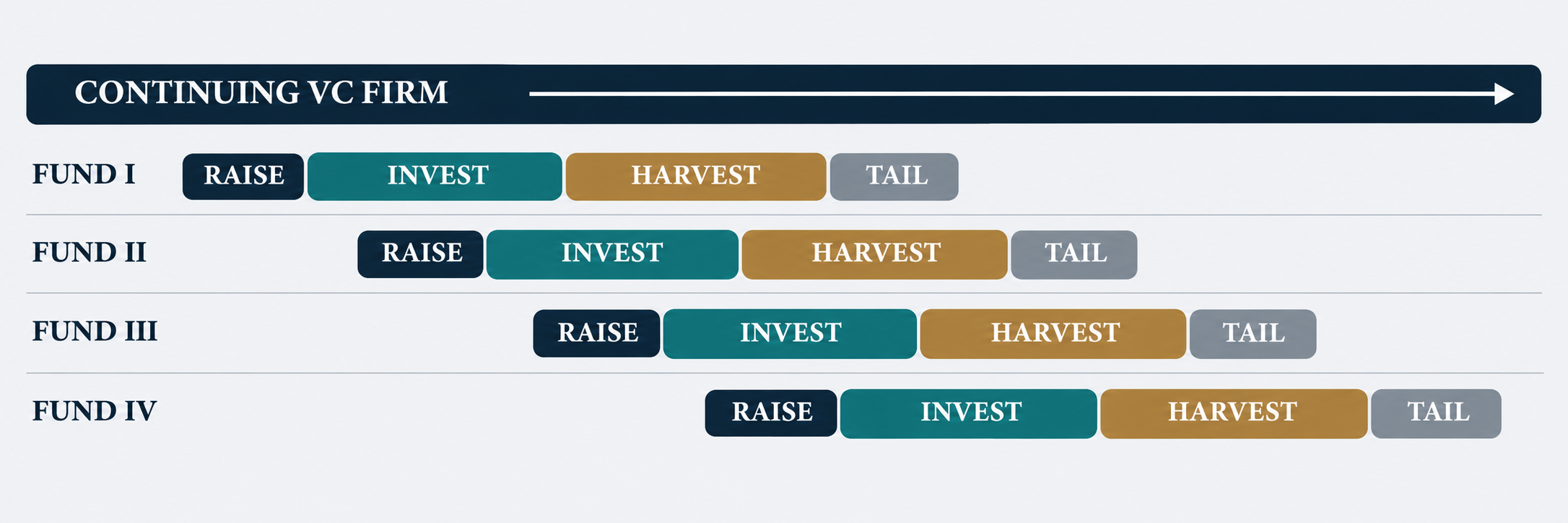
Managing successive funds can create a sourcing advantage. Former portfolio founders refer new teams, earlier diligence sharpens the firm’s view of sector risks and realized distributions strengthen LP confidence. Larger funds, however, require investment outcomes that matter at a larger scale. A firm that excelled at small seed cheques may enter later-stage rounds to deploy a bigger corpus and encounter competitors with deeper operating or pricing expertise. Each new fund should therefore test whether the firm’s original advantage remains relevant at its new size rather than confuse increased assets under management with better investment judgment.
Successive funds may also face conflicts that the VC firm’s investment committee cannot resolve by reference to the firm’s interests alone. Suppose Fund I seeks liquidity from a company that Fund III wishes to buy. Fund I needs a defensible sale price; Fund III needs an independently attractive investment. The VC firm must examine the applicable SEBI requirements for conflicted and inter-scheme transactions, its allocation policy, each fund’s documents and appropriate valuation and approval arrangements. The same discipline applies when fund compete for follow-on capacity or attractive new opportunities.
As the firm matures, it must transfer judgment as well as titles. Equity ownership in the management company, fund-specific carried interest and investment authority create different interests; succession must address them separately. Changes of key persons or control may also have regulatory and contractual consequences. Some VC firms will remain specialists; others will broaden their strategy, combine with another institution or close. The enduring firm develops new partners, honours its promises across successive funds and deals candidly with investments that disappoint. Its reputation rests on the decisions it makes for investors and founders throughout the life of each fund.
BIBLIOGRAPHY
Indian Legislation
- Companies Act, 2013
- Securities and Exchange Board of India (Alternative Investment Funds) Regulations, 2012
- SEBI, Master Circular for Alternative Investment Funds (AIFs)
- SEBI, Guidelines for Winding Up of AIFs with Respect to Retention of Proceeds and “Inoperative Fund” Status circular dated 16 June 2026.
Market Reports
- Bain & Company and Indian Venture and Alternate Capital Association (IVCA), India Venture Capital Report 2026 (2026).
- Grant Thornton Bharat and IVCA, Emerging Managers Report 2026: From First Fund to Lasting Franchise (2026).
Books on Venture Capital
- Jeffrey Bussgang, Mastering the VC Game: A Venture Capital Insider Reveals How to Get from Start-Up to IPO on Your Terms (Portfolio, 2010).
- Brad Feld and Jason Mendelson, Venture Deals: Be Smarter Than Your Lawyer and Venture Capitalist (4th ed., Wiley, 2019).
- Paul A. Gompers and Josh Lerner, The Venture Capital Cycle (2nd ed., MIT Press, 2004).
- Kshitija Joshi, The Economics of Venture Capital Firm Operations in India (Cambridge University Press, 2020).
- Scott Kupor, Secrets of Sand Hill Road: Venture Capital and How to Get It (Portfolio, 2019).
- Sebastian Mallaby, The Power Law: Venture Capital and the Making of the New Future (Penguin Press, 2022).
- Andrew Metrick and Ayako Yasuda, Venture Capital and the Finance of Innovation (3rd ed., Wiley, 2021).
- Tom Nicholas, VC: An American History (Harvard University Press, 2019).
- Mahendra Ramsinghani, The Business of Venture Capital: The Art of Raising a Fund, Structuring Investments, Portfolio Management, and Exits (3rd ed., Wiley, 2021).
- Tarang Shah and Sheetal Shah, Venture Capitalists at Work: How VCs Identify and Build Billion-Dollar Successes (Apress, 2011).
- Ilya A. Strebulaev and Alex Dang, The Venture Mindset: How to Make Smarter Bets and Achieve Extraordinary Growth (Portfolio, 2024).
Illustrative Company Accounts
- Fred Wilson, Twitter, Union Square Ventures (25 July 2007).
- Ingrid Lunden, Fab Was Burning Through $14M/Month Before Its Layoffs and Pivot, TechCrunch (20 October 2014).