
1. Why impairment valuation matters
Assets are carried on the balance sheet on the premise that the business will recover their value through use or sale. When that premise breaks, because of a lost customer, a regulatory change, a failed product or a sharp rise in interest rates, the carrying amount can exceed what the asset can realistically generate. Impairment accounting forces management to recognise that shortfall as a loss rather than letting it sit hidden in the balance sheet.
For valuers, impairment work is different from a transaction or fairness valuation. The objective is not to find a price a buyer might pay in general, but to test whether a specific carrying amount is supportable under a specific accounting standard. That means the framework, the unit of account and the permitted inputs are all dictated by the standard, and auditors will scrutinise each of them.
In short:
- Trigger: a lost customer, regulatory change, failed product or sharp rise in interest rates.
- Result: the shortfall between carrying amount and realistic cash generation is recognised as a loss.
- Valuer’s task: test whether a specific carrying amount is supportable under a specific standard.
2. The governing framework
- Ind AS 36 (Impairment of Assets), converged with IAS 36 and applicable to most Indian companies. It covers property, plant and equipment, intangibles, goodwill, right-of-use assets and investments in subsidiaries, associates and joint ventures. Financial assets within Ind AS 109 and inventories, deferred tax assets and others have their own standards.
- Ind AS 113 (Fair Value Measurement) governs how fair value less costs of disposal is measured.
- Valuation standards, namely the ICAI Valuation Standards (including those on business valuation and intangible assets) and the International Valuation Standards (IVS), guide the approach, documentation and reporting.
The core rule is simple: an asset is impaired when its carrying amount exceeds its recoverable amount, and the excess is recognised as an impairment loss in profit or loss (or against revaluation surplus where applicable).
3. The key concepts
Carrying amount
The amount at which the asset or unit is recognised in the books after depreciation, amortisation and prior impairments. A surprising number of impairment disputes begin here, because the carrying amount of a unit has to be assembled consistently with the cash flows being tested.
- Starts from book value after depreciation, amortisation and prior impairments.
- Must be assembled consistently with the cash flows being tested.
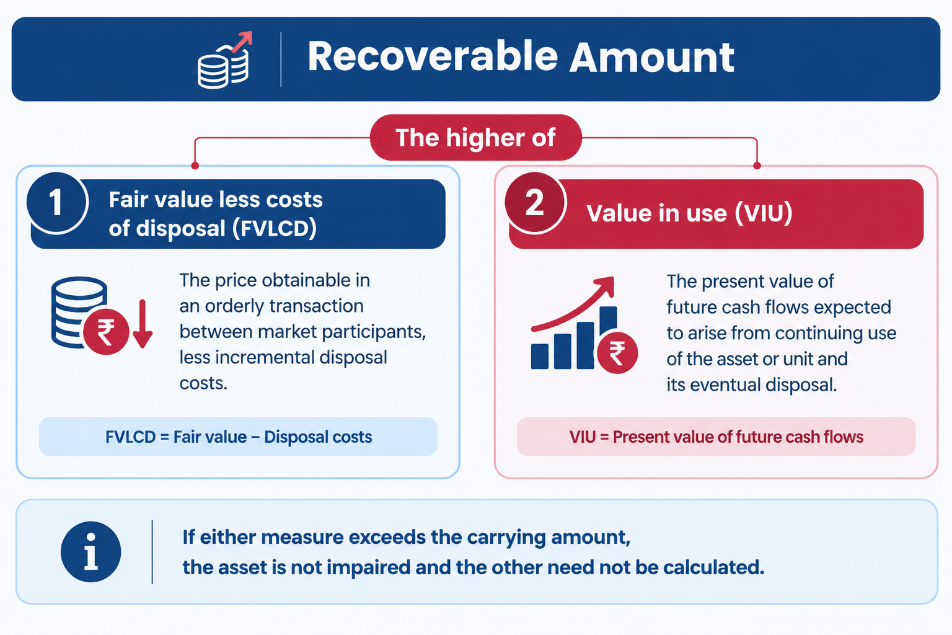
Recoverable amount:
The higher of:
- Fair value less costs of disposal (FVLCD), the price obtainable in an orderly transaction between market participants, less incremental disposal costs.
- Value in use (VIU), the present value of future cash flows expected to arise from continuing use of the asset or unit and its eventual disposal.
If either measure exceeds the carrying amount, the asset is not impaired and the other need not be calculated.
Cash-generating unit (CGU)
Most assets do not generate independent cash inflows. The test is therefore run at the smallest identifiable group of assets whose cash inflows are largely independent of other assets or groups. Defining the CGU is a judgement that must be applied consistently year to year.
- The smallest identifiable group of assets with largely independent cash inflows.
- Its definition is a judgement and must be applied consistently year to year.
Goodwill allocation
Goodwill is allocated to the CGUs or groups of CGUs expected to benefit from the synergies of the business combination, at a level no larger than an operating segment.
- Allocated to CGUs, or groups of CGUs, expected to benefit from the synergies.
- The allocation level can be no larger than an operating segment.
4. When to test
| Asset type | Testing requirement |
| Goodwill | At least annually, and whenever there is an indicator |
| Intangibles with indefinite life | At least annually |
| Intangibles not yet available for use | At least annually |
| All other assets | At each reporting date, if an indicator of impairment exists |
Typical indicators include:
- External: significant fall in market value, adverse changes in technology, market, economic or legal environment, rising interest rates, market capitalisation below net assets.
- Internal: obsolescence or physical damage, plans to discontinue or restructure, assets becoming idle, economic performance worse than expected.
- For investments in subsidiaries or associates: dividend exceeding comprehensive income, or carrying amount exceeding the consolidated carrying amount of net assets including goodwill.
5. Value in use: step by step
VIU is a discounted cash flow exercise, but with constraints that differ from a typical market-based DCF.
Step 1: Forecast cash flows
- Use management’s most recent approved budgets and forecasts, normally covering a maximum of five years unless a longer period can be justified.
- Base assumptions on reasonable and supportable evidence, giving more weight to external evidence.
- Compare previous forecasts with actual results to test management’s forecasting accuracy.
- Cash flows must reflect the asset in its current condition. Exclude uncommitted restructurings and future capital expenditure that enhances performance.
- Exclude financing cash flows and income tax cash flows, since the discount rate is pre-tax.
- Include the net cash flows from eventual disposal at the end of the useful life.
Step 2: Estimate the terminal value
- Extrapolate beyond the explicit period using a steady or declining growth rate, which should not exceed the long-term average growth rate for the products, industries or country in which the entity operates.
- Terminal-year cash flows should be normalised, with capital expenditure sufficient to maintain the asset base.
Step 3: Select the discount rate
- The standard requires a pre-tax rate reflecting current market assessments of the time value of money and the risks specific to the asset, for which future cash flow estimates have not been adjusted.
- In practice, valuers usually derive a post-tax WACC and then convert it to a pre-tax equivalent, by iteration so that post-tax cash flows discounted at the post-tax rate give the same value as pre-tax cash flows discounted at the pre-tax rate.
- Build the WACC from observable market evidence: risk-free rate, equity risk premium, beta from comparable companies, size or specific-risk premium where justified, cost of debt and a market-participant capital structure.
Step 4: Discount and compare
Discount the cash flows and compare the result with the carrying amount of the CGU. Where the CGU contains goodwill, the carrying amount must include it (and any corporate assets allocated to it).
6. Fair value less costs of disposal
FVLCD uses market-participant assumptions rather than the entity’s own plans. Ind AS 113 and the valuation standards recognise three broad approaches. The valuer selects the approach, or combination of approaches, that best fits the asset or CGU and the data available, and should ideally cross-check the result with a second approach.
Income approach
The income approach values the CGU at the present value of the cash flows a market participant would expect it to generate. It is the usual primary approach for an operating business, because goodwill and most intangibles earn their return through future cash flows.
- Build market-participant cash flows. Start from management’s forecast, then remove entity-specific assumptions and adjust to what a typical buyer would assume. Unlike VIU, these cash flows may include synergies available to any market participant and growth initiatives or restructurings a buyer would carry out.
- Choose the forecast period. Project explicitly until the business reaches a steady state, which can be longer than five years for a growing or recovering business.
- Estimate the terminal value. Apply the Gordon growth method to a normalised final-year cash flow, or use an exit multiple derived from market evidence. Check that the implied growth rate or multiple is reasonable.
- Discount at a market-participant rate. Apply a post-tax WACC to post-tax cash flows. Build the WACC from the risk-free rate, equity risk premium, comparable-company beta, any justified size or specific-risk premium, cost of debt and a market-participant capital structure.
- Compare the implied multiples with market evidence and test the sensitivity of the result to the discount rate, growth rate and margins.
For an individual intangible asset, common income-approach methods include relief from royalty (the royalty saved by owning the asset rather than licensing it) and the multi-period excess earnings method (MPEEM), which isolates the cash flows attributable to the asset after charging a return on the other contributory assets.
- Best suited to: operating businesses and CGUs with reliable forecasts, and cases where comparable companies or transactions are scarce.
- Watch-outs: over-optimistic forecasts, a terminal value that makes up most of the total, a mismatch between the basis of the cash flows (post-tax, nominal) and the discount rate, and double-counting synergies already included in the market-participant cash flows.
Market approach
The market approach infers value from the prices at which similar businesses or assets are traded. It is evidence-based and easy for auditors to corroborate, but it is only as good as the comparability of the peer set.
- Identify comparables. Select listed companies (guideline public companies) or completed transactions with a similar business, geography, size, growth and risk. Where the CGU is a listed subsidiary, its own quoted price in an active market is the most direct evidence (Level 1).
- Select the multiple. EV/EBITDA is the most common for operating businesses because it is neutral to capital structure and depreciation policy. EV/EBIT, EV/Revenue or P/E may be used where EBITDA is not meaningful, for example for loss-making or early-stage businesses.
- Normalise the data. Calculate each peer’s multiple on a consistent basis (the same period, such as last twelve months or forward, and the same accounting treatment), adjusting for non-recurring items, lease treatment and differing year-ends.
- Adjust for differences. Reflect differences in size, growth, profitability, leverage and liquidity, and consider whether the evidence reflects a minority trading price or a control transaction. Precedent transactions carry a control premium, whereas trading multiples generally do not.
- Apply and bridge. Apply the selected multiple to the CGU’s metric to arrive at enterprise value, then make sure the result is comparable with how the carrying amount is defined: enterprise value against operating assets, equity value against net assets.
- Best suited to: businesses with an active peer group or recent comparable deals, and as a cross-check on an income-approach result.
- Watch-outs: thin peer sets, outliers, multiples that reflect short-term market sentiment, stale precedent deals, and comparing an enterprise value with a carrying amount defined at equity level (or the reverse).
Cost approach
The cost approach asks what it would cost a market participant to obtain an asset of equivalent utility. It is mainly used for specialised physical assets and for intangibles whose income cannot be isolated.
- Estimate current cost new. Use reproduction cost (an exact replica) or, more commonly, replacement cost (a modern equivalent), supported by vendor quotes, price lists or indexed historical cost. Include installation, freight and commissioning.
- Deduct physical deterioration. Reflect age and wear, based on the remaining life against the total life.
- Deduct functional obsolescence. Reflect inferior design, higher operating costs or surplus capacity compared with a modern equivalent.
- Deduct economic obsolescence. Reflect external factors such as falling demand, regulation or thin margins that stop the asset from earning a return on its cost. This step links the cost approach to impairment and is often missed.
- Best suited to: plant and machinery, buildings, specialised or customised equipment, and software or other intangibles with an identifiable cost to recreate. Land is normally valued using the market approach.
- Watch-outs: the approach rarely captures goodwill or the earning power of a business, so it is seldom adequate on its own for a CGU, and it overstates value if economic obsolescence is ignored.
Deduct costs of disposal such as legal fees, transaction taxes and costs of getting the asset ready for sale. Finance costs and income tax expense are excluded.
The fair value hierarchy under Ind AS 113 determines disclosure. Where unobservable inputs dominate, the measurement is Level 3 and requires fuller disclosure of techniques and key inputs.
Choosing and reconciling the approaches
The approaches are not alternatives to be picked at random. The valuer weighs the nature of the asset, the quality of the forecasts and the availability of market evidence, and then reconciles any differences. A material gap between approaches usually points to an inconsistent assumption, such as an aggressive forecast or an unsuitable peer set, and should be investigated rather than averaged away.
| Approach | Best suited to | Key inputs | Typical Ind AS 113 level |
| Income | Operating businesses and CGUs with goodwill | Forecasts, post-tax WACC, terminal growth | Level 3 |
| Market | Businesses with listed peers or recent deals; listed subsidiaries | Peer multiples or quoted prices, size and growth adjustments | Level 1 for quoted prices; Level 2 or 3 for multiples |
| Cost | Specialised physical assets and some intangibles | Current cost new, obsolescence factors | Level 2 or 3 |
How the income approach differs for VIU and FVLCD
Both measures often use a discounted cash flow, which is why they are easily confused. The standard requires them to be built differently.
| Feature | Value in use | FVLCD (income approach) |
| Perspective | Entity-specific: the asset as the entity uses it | Market participant |
| Cash flows | Asset in its current condition; no uncommitted restructuring or performance-enhancing capital expenditure | May include synergies, restructuring and growth initiatives that market participants would pursue |
| Forecast period | Latest approved budgets, normally up to five years, then a steady or declining growth rate | As long as needed to reach a steady state |
| Tax and discount rate | Income tax cash flows excluded; pre-tax discount rate | Post-tax cash flows; post-tax market-participant WACC |
| Disposal | Net cash flows from eventual disposal at the end of the useful life included | Costs of disposal deducted from the resulting value |
7. Recognising and allocating the loss
If the carrying amount of a CGU exceeds its recoverable amount, the loss is allocated in this order:
- First, reduce the carrying amount of goodwill allocated to the CGU.
- Then reduce the other assets of the CGU pro rata based on carrying amounts.
No asset may be reduced below the highest of its FVLCD, its VIU (if determinable) and zero.
Reversals: An impairment loss on assets other than goodwill can be reversed if there has been a change in the estimates used to determine recoverable amount. The reversal cannot take the carrying amount above what it would have been net of depreciation had no impairment been recognised. Impairment of goodwill is never reversed.
8. A simple illustration
A CGU has a carrying amount of INR 500 crore, made up of goodwill of INR 120 crore, property, plant and equipment of INR 230 crore, other intangibles of INR 60 crore, right-of-use assets of INR 30 crore and net working capital of INR 60 crore.
- Value in use: pre-tax cash flows of INR 40, 45, 49, 52 and 55 crore over five years, plus a terminal value at 3% growth, discounted at a pre-tax rate of 14%, give a VIU of INR 430 crore.
- FVLCD: EBITDA of INR 52 crore at a selected peer multiple of 8.0x gives INR 416 crore, less INR 6 crore of costs of disposal, so FVLCD is INR 410 crore.
- Recoverable amount is the higher figure, INR 430 crore.
- Impairment loss = 500 − 430 = INR 70 crore, allocated entirely to goodwill, leaving INR 50 crore of goodwill and no change to other assets.
| Component (INR crore) | Before | Impairment | After |
| Goodwill | 120 | (70) | 50 |
| Other assets of the CGU | 380 | – | 380 |
| Total | 500 | (70) | 430 |
Sensitivity: if the pre-tax discount rate were 15%, VIU would fall to about INR 393 crore. FVLCD of INR 410 crore would then become the recoverable amount, and the loss would be INR 90 crore.
9. Conclusion
Impairment valuation sits at the intersection of accounting rules and valuation judgement. The mechanics, recoverable amount against carrying amount, are straightforward. The difficulty lies in the details: choosing the CGU, supporting the forecasts, deriving a defensible discount rate and showing how sensitive the conclusion is to each assumption. A well-documented, consistently applied and market-checked valuation is what allows management, auditors and regulators to rely on the result.
Key takeaways:
- The mechanics are simple: recoverable amount against carrying amount.
- The difficulty lies in the CGU, the forecasts, the discount rate and the sensitivity.
- Documentation, consistency and a market cross-check are what make the result reliable.
This article is general information on the accounting and valuation framework. Specific engagements should be assessed against the full text of the applicable standards and professional guidance.