
1. Introduction
A transfer of equity shares takes on a very different compliance character depending on two things: who is transferring to whom, and what kind of company’s shares are being transferred. The residential status of the transferor and the transferee decides which statute takes the lead, the Income-tax Act, 2025 alone for a purely domestic transaction, or the Income-tax Act, 2025 read together with the Foreign Exchange Management Act, 1999 (FEMA) the moment a non-resident is on either side of the transaction. Layered on top of residential status is the nature of the company whose shares are being transferred, listed Indian company, unlisted Indian company, or foreign company, each of which triggers its own set of pricing, reporting, and procedural requirements.
This article maps out that compliance landscape scenario by scenario. It works through four broad residency-based categories, resident to resident, resident to non-resident, non-resident to resident, and non-resident to non-resident, and within each, examines the transfer of listed Indian company shares, unlisted Indian company shares, and foreign company shares separately. This gives twelve distinct fact patterns, each with its own governing framework, pricing considerations, and reporting obligations.
This article is confined to the transfer-specific compliance framework, the applicable laws, pricing rules, reporting forms, and procedural steps for each scenario. The determination of Fair Market Value itself under Rule 57 of the Income-tax Rules, 2026, and the resulting tax charge under Section 92(2)(m)(iii) of the Income-tax Act, 2025, are dealt with in a separate, dedicated article and are only referred to here where relevant to a transfer scenario.
2. Regulatory Framework at a Glance
Before working through the individual scenarios, it helps to note the four statutory strands that recur across them, in varying combinations:
● Companies Act, 2013 – governs the mechanics of transfer for Indian companies: transfer deeds, board approval, and updating the register of members, applicable regardless of the residential status of the parties.
● FEMA, 1999 and regulations made under it – the Foreign Exchange Management (Non-Debt Instruments) Rules, 2019 govern inbound and outbound transfers of capital instruments of an Indian company involving a non-resident, while the Foreign Exchange Management (Overseas Investment) Rules, 2022 govern a resident’s acquisition or transfer of shares in a foreign company.
● Income-tax Act, 2025 – determines the tax consequences for each party: capital gains for the seller, Section 92(2)(m)(iii) for a recipient who pays less than Fair Market Value, Section 9 deeming provisions for gains on Indian-situs assets, Section 161 for transfer pricing between associated enterprises, and Section 393(2) (Table Serial No. 17, corresponding to the erstwhile Section 195) for withholding tax on payments to non-residents.
● SEBI regulations – relevant wherever listed shares are involved, whether the transfer happens on the stock exchange or is routed off-market, and for pricing of preferential allotments and other specified transactions.
Which of these strands apply, and how strictly, depends entirely on the scenario. The sections that follow work through each of the twelve combinations in turn.
It is also worth flagging, at the outset, what is at stake in getting the applicable framework wrong. A missed or late FEMA filing can attract compounding proceedings and a monetary penalty under FEMA, quite apart from any income-tax consequence. A transfer priced outside the FEMA pricing guideline can be treated as a contravention even where the parties believed the price to be commercially fair, since FEMA pricing compliance is assessed against the prescribed methodology rather than against general reasonableness. Equally, a failure to withhold tax where a non-resident is involved exposes the resident payer to disallowance of the related expense and to interest and penalty under the Income-tax Act, regardless of whether the non-resident ultimately pays the correct tax on their own return. Identifying the correct scenario before the transaction is signed, rather than after funds have moved, is therefore not a mere formality.
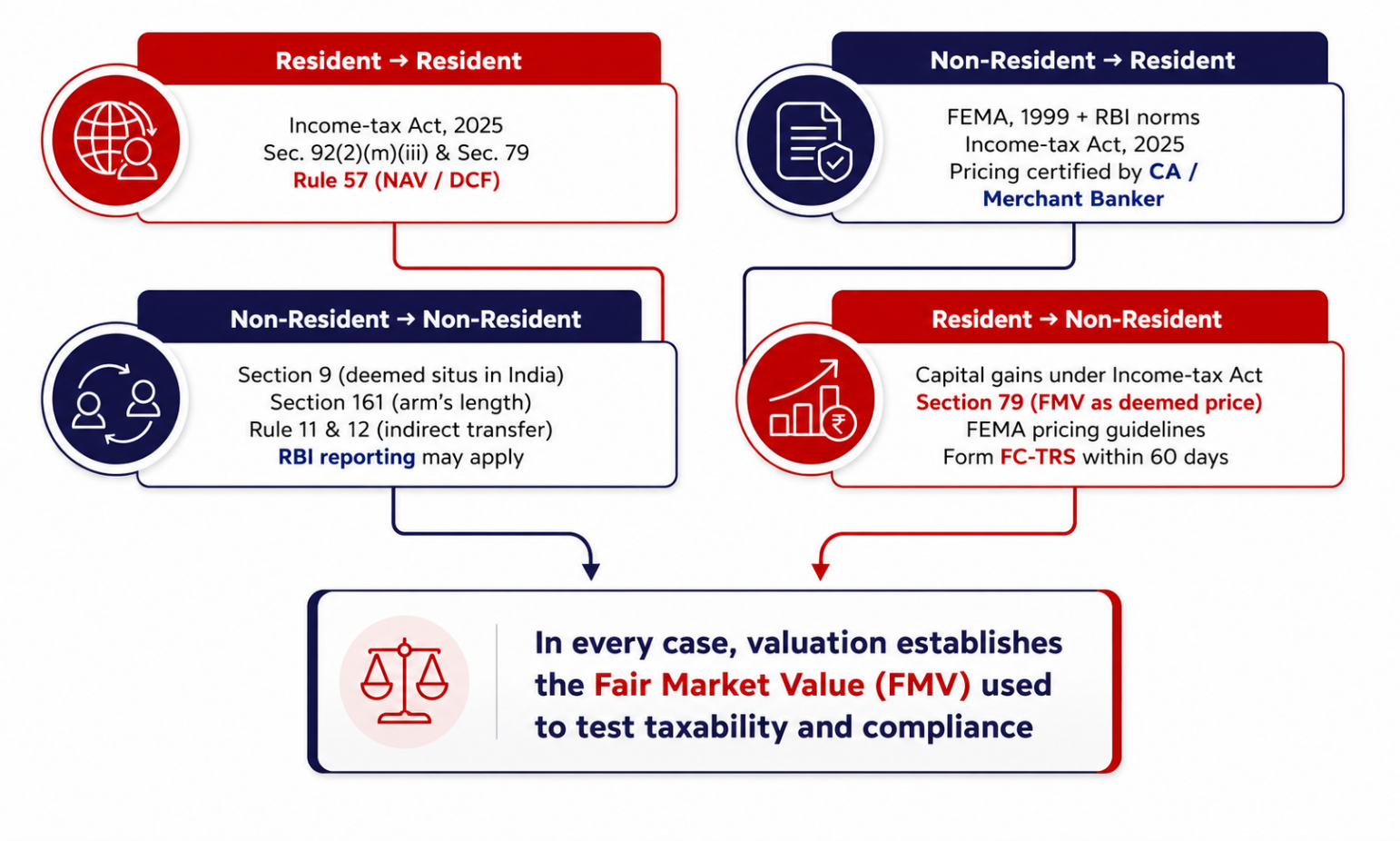
3. Resident to Resident Transfers

Where both the transferor and the transferee are residents of India, the transaction is, in principle, a domestic one and falls outside FEMA and RBI jurisdiction. The governing framework is the Companies Act, 2013 for the mechanics of transfer, and the Income-tax Act, 2025 for the tax consequences. The one exception within this category is where the shares being transferred are themselves shares of a foreign company, in which case the underlying asset pulls the transaction back into the FEMA overseas investment framework even though both parties are residents.
3.1 Listed Indian Company
Transfers of listed equity shares between two residents are usually executed through a recognised stock exchange, where shares are matched electronically and settled through the depository system. Because these transfers happen on-market, the transaction price is transparent and set by the market itself, with Securities Transaction Tax (STT) applying to the trade.
An off-market transfer between residents, moving shares directly between demat accounts without a stock exchange trade, is also permitted and is common for gifts, inter-family transfers, or negotiated block deals. Off-market transfers require a delivery instruction to the depository participant and attract stamp duty, collected through the depository system at the prescribed rate. Since both parties are residents and the company is Indian, there is no RBI or FEMA reporting requirement for either an on-market or an off-market transfer.
Capital gains tax applies to the resident seller depending on the holding period and the nature of the transfer, with the applicable rate and indexation treatment differing for transfers executed through a recognised stock exchange as against off-market transfers.
From a documentation standpoint, an on-market sale generates its own contract note and settlement record through the broker and depository, which is generally sufficient evidence of price for tax purposes. An off-market gift or family transfer, by contrast, is better supported by a simple transfer instruction, a gift deed where no consideration passes, and a note recording the relationship between the parties, since a below-market price between related residents can invite scrutiny even though no FEMA filing is involved.
3.2 Unlisted Indian Company
Unlisted shares are transferred by way of a share transfer deed in Form SH-4 under the Companies Act, 2013, executed by both the transferor and the transferee, accompanied by the share certificate, and submitted to the company for board approval. On approval, the company updates its register of members and issues a fresh share certificate in the transferee’s name. Stamp duty is payable on the transfer deed at the rate prescribed under the Indian Stamp Act or the applicable state stamp legislation.
Because unlisted shares have no observable market price, the price at which the shares are actually transferred assumes tax significance. Where the consideration paid is lower than the Fair Market Value determined under Rule 57, the shortfall may be brought to tax as income in the hands of the recipient under Section 92(2)(m)(iii), or as deemed capital gains in the hands of the seller under Section 79, depending on the facts. No FEMA or RBI compliance arises, since both parties are residents and the company is Indian; the compliance burden here is essentially documentary, transfer deed, board resolution, indemnity where shares are physical, and a properly supported valuation where related parties are involved.
It is worth noting that a private company’s own articles of association may impose additional restrictions on transfer, such as a right of first refusal in favour of existing shareholders or a requirement of prior board consent before a transfer is registered. These contractual restrictions apply independently of, and in addition to, the statutory and tax requirements discussed above, and are frequently the first point encountered in a resident-to-resident transfer of unlisted shares.
3.3 Foreign Company
A transfer between two residents can also involve shares of a foreign company, for instance, where a resident individual or entity holds shares in an overseas company acquired through the Liberalised Remittance Scheme, an Overseas Direct Investment structure, or an employee stock option, and transfers them to another resident. Even though both parties are residents, the underlying asset is foreign, and the transaction is therefore governed by the Foreign Exchange Management (Overseas Investment) Rules, 2022.
The transferor is generally required to report the transfer through the prescribed overseas investment forms filed with the Reserve Bank of India via an Authorised Dealer bank, and the transferee, on acquiring the shares, takes on the corresponding reporting obligations going forward, including disclosure of the foreign holding in Schedule FA of their income-tax return. On the tax side, the resident transferor is liable to capital gains tax on the transfer in the ordinary course, computed with reference to the acquisition cost and holding period of the foreign shares.
Because the transaction sits between two residents but concerns a foreign asset, it is easy to overlook the overseas investment reporting angle entirely, particularly where the transfer takes the form of an inheritance, a family settlement, or an intra-group restructuring rather than a straightforward sale. Both parties are well advised to route the transfer through their Authorised Dealer bank so that the change in ownership is correctly reflected in the transferor’s disinvestment records and the transferee’s ongoing overseas investment reporting.
4. Resident to Non-Resident Transfers
A transfer from a resident to a non-resident is a cross-border transaction from the Indian company’s perspective, since it results in a non-resident acquiring an equity interest in, or increasing an existing equity interest in, either an Indian company or a foreign company. Where the underlying company is Indian, the transaction falls squarely within the Foreign Exchange Management (Non-Debt Instruments) Rules, 2019, and requires reporting on the FIRMS portal. Where the underlying company is foreign, it is instead a disinvestment by the resident under the overseas investment framework.
4.1 Listed Indian Company
Where a resident transfers listed shares to a non-resident, the transfer must comply with the pricing guidelines prescribed under the FEMA (Non-Debt Instruments) Rules, 2019, which, for listed companies, require the price to be in line with SEBI’s applicable pricing regulations for the relevant mode of transfer, whether a preferential allotment, a secondary market purchase, or an off-market transfer. Sectoral caps and conditions on foreign direct investment must also be checked, since certain sectors permit foreign investment only up to a specified limit, or only under the government approval route.
The transaction must be reported on Form FC-TRS through the FIRMS portal within 60 days of the transfer or of receipt of funds, whichever is earlier. On the tax side, the resident seller is liable to capital gains tax on the transfer, computed under the ordinary capital gains provisions applicable to listed equity shares.
Where the transfer is a secondary market purchase by the non-resident on the stock exchange itself, the pricing requirement is automatically satisfied by the exchange-determined price, and the FC-TRS filing becomes largely a reporting formality. It is off-market or preferential transactions involving a non-resident that call for closer attention to the applicable SEBI pricing formula and to the specific FDI conditions attaching to the sector in which the Indian company operates.
4.2 Unlisted Indian Company
For unlisted shares, the FEMA pricing guidelines require that the transfer price paid by the non-resident is not less than the fair value of the shares, determined using internationally accepted valuation methodologies such as the Discounted Cash Flow method, and certified by a Chartered Accountant, a practising Cost Accountant, or a SEBI-registered Merchant Banker. This pricing floor exists to prevent value from being shifted out of India at an artificially depressed price.
As with listed shares, the transaction is reported through Form FC-TRS on the FIRMS portal within 60 days, and sectoral caps and conditions applicable to the specific industry must be verified before the transfer proceeds. Where the actual transfer price is lower than the Fair Market Value determined for income-tax purposes, Section 79 may separately apply to deem the FMV as the resident seller’s sale consideration for computing capital gains, in addition to the FEMA pricing floor being met.
In practice, the same valuation report often serves both purposes, the FEMA pricing floor and the income-tax FMV benchmark, provided the valuer applies a method acceptable under both frameworks and the valuation date aligns with the date of transfer. Divergence between the two figures, which can arise where different methodologies are used for FEMA and income-tax purposes, is best resolved before the transaction closes rather than after a regulatory query is raised.
4.3 Foreign Company
Where a resident transfers shares of a foreign company to a non-resident, for instance winding down an overseas holding built up through an Overseas Direct Investment or acquired via the Liberalised Remittance Scheme, the transaction is a disinvestment governed by the Overseas Investment Rules, 2022 rather than the NDI Rules, since the underlying company is not Indian.
The resident transferor is required to report the disinvestment to the Reserve Bank of India through the Authorised Dealer bank, within the timelines prescribed for disinvestment reporting under the overseas investment framework, and to repatriate any sale proceeds due to India in accordance with FEMA requirements. On the tax side, capital gains arising to the resident on the sale of the foreign shares are taxable in India in the ordinary course, subject to any relief available under an applicable double taxation avoidance agreement if the non-resident buyer’s jurisdiction taxes the gain as well.
Where the disinvestment is only partial, the resident retaining a residual holding in the foreign company, the reporting and repatriation requirements apply only to the portion actually transferred, and the resident’s ongoing Annual Performance Report obligations continue in respect of the shares still held. Getting the residual shareholding correctly reflected in subsequent regulatory filings is a common practical gap in partial disinvestment transactions.
5. Non-Resident to Resident Transfers

A transfer from a non-resident to a resident is the mirror image of the previous category. Where the underlying company is Indian, it results in a non-resident exiting an Indian investment, and the FEMA pricing guidelines here work in the opposite direction, capping the price rather than setting a floor, so that a resident buyer cannot be made to overpay in a manner that facilitates an indirect outflow of value. Where the underlying company is foreign, it is instead a resident acquiring an overseas asset.
5.1 Listed Indian Company
A non-resident transferring listed shares to a resident must still comply with SEBI’s applicable pricing norms for the relevant mode of transfer, and the transaction continues to require reporting on Form FC-TRS through the FIRMS portal within 60 days, since the reporting obligation applies whenever a non-resident is a party to the transfer, regardless of the direction.
The non-resident seller is liable to capital gains tax in India on the sale, since the gain arises from an Indian-situs asset. Where the shares are held through a recognised stock exchange and are subject to STT, this feeds into the applicable capital gains rate. The resident buyer, as the payer, is generally required to withhold tax under Section 393(2) (Table Serial No. 17) of the Income-tax Act, 2025, before remitting or crediting the consideration, subject to any lower or nil withholding certificate obtained by the non-resident seller and any relief available under a double taxation avoidance agreement, supported by the seller’s Tax Residency Certificate and self-declaration.
Where the non-resident seller is unable to obtain a lower or nil withholding certificate before the transaction closes, tax is withheld at the full applicable rate and the seller then claims a refund of the excess through an Indian income-tax return, which can tie up funds for a considerable period. Applying for the certificate well ahead of the intended transfer date, rather than after price negotiations conclude, avoids this cash-flow drag.
5.2 Unlisted Indian Company
For unlisted shares, the FEMA pricing guidelines require that the transfer price paid by the resident does not exceed the fair value of the shares as determined by a Chartered Accountant, a practising Cost Accountant, or a SEBI-registered Merchant Banker using internationally accepted methods, the reverse of the pricing floor that applies on a resident-to-non-resident transfer. Form FC-TRS reporting through the FIRMS portal within 60 days continues to apply.
The non-resident seller remains liable to capital gains tax in India, and the resident buyer must withhold tax under Section 393(2) (Table Serial No. 17) at the applicable rate, again subject to a lower or nil deduction certificate and any double taxation avoidance agreement relief the seller is able to substantiate. Given the absence of a market price for unlisted shares, both the FEMA pricing cap and the income-tax withholding calculation typically rely on the same underlying valuation exercise.
A resident buyer acquiring unlisted shares from a non-resident should also confirm that the transaction does not breach any sectoral cap or entry condition applicable to the Indian company, since a resident-to-resident shift in beneficial ownership following an earlier round of foreign investment can still leave downstream compliance obligations that need to be squared away as part of the same transaction.
5.3 Foreign Company
Where a non-resident transfers shares of a foreign company to a resident, the resident is, in substance, making a fresh overseas investment or acquisition, and the transaction is governed by the Overseas Investment Rules, 2022 for an entity, or by the Liberalised Remittance Scheme limits for a resident individual acquiring the shares in their personal capacity.
Depending on the sector and the structure through which the resident is acquiring the shares, the acquisition may fall under the automatic route or may require prior approval, and reporting to the Reserve Bank of India through the Authorised Dealer bank on the prescribed overseas investment forms is generally required within the timelines specified for reporting an overseas acquisition.
Individuals relying on the Liberalised Remittance Scheme should also keep in mind the overall annual remittance limit under the Scheme, which caps the aggregate amount that can be sent abroad for all permitted purposes in a financial year, so that an acquisition of this kind is planned alongside any other overseas remittances the individual may have made or intends to make in the same year.
6. Non-Resident to Non-Resident Transfers

A transfer between two non-residents might appear, at first glance, to fall entirely outside Indian jurisdiction. That is not the case wherever the underlying asset, directly or indirectly, derives its value from India. The Income-tax Act, 2025 deems shares of an Indian company, and in certain circumstances shares of a foreign company that derive substantial value from Indian assets, to be situated in India, bringing the transaction within the Indian tax net even though neither party is a resident.
6.1 Listed Indian Company
Gains arising to a non-resident on the transfer of listed shares of an Indian company to another non-resident are taxable in India under Section 9 of the Income-tax Act, 2025, since the shares of an Indian company are deemed to be situated in India regardless of where the transferor or transferee is located. Form FC-TRS is not ordinarily required for a transfer between two non-residents, since the FEMA reporting framework is built around a change between resident and non-resident holding, but the Indian company should still be intimated so that its register of members and any FDI-related disclosures remain accurate.
The non-resident buyer, as payer, is generally required to withhold tax under Section 393(2) (Table Serial No. 17) before remitting the consideration, a practical obligation that can be administratively difficult for a foreign buyer with no existing presence in India, and relief under an applicable double taxation avoidance agreement should be examined on both sides of the transaction.
Because the buyer in this scenario is itself a non-resident with no Indian withholding infrastructure in place, it is common, and generally advisable, for the transaction documentation to expressly allocate responsibility for obtaining a TAN, computing the withholding, and depositing it with the Indian tax authorities, so that neither party is caught unaware by an obligation that arises out of an Indian-situs asset despite the transaction occurring entirely between two non-residents.
6.2 Unlisted Indian Company
The same Section 9 deeming provision applies to a transfer of unlisted shares of an Indian company between two non-residents, taxing the gain in India regardless of the residential status of either party. No FEMA reporting is ordinarily triggered for the transfer itself, though the resulting change in the ultimate non-resident ownership of the Indian company may need to be reflected in the company’s downstream investment disclosures where the Indian company itself has foreign investment linked to sectoral caps.
Where the transferor and transferee are associated enterprises, the transfer pricing provisions under Section 161 of the Income-tax Act, 2025 require the transaction to be benchmarked at arm’s length, independent of the Section 9 taxability question, and supporting documentation for the arm’s length price should be maintained.
Even where no FEMA filing is triggered, the Indian company should update its statutory registers to reflect the new non-resident shareholder and should verify whether the change affects any representations it has previously given to lenders, joint venture partners, or regulators regarding its shareholding pattern, particularly in sectors where downstream ownership and control are separately monitored.
6.3 Foreign Company (Indirect Transfer)
The most complex of the twelve scenarios arises where two non-residents transfer shares of a foreign company that derives substantial value from assets located in India, an indirect transfer. Under the indirect transfer provisions of the Income-tax Act, 2025, such shares are deemed to be situated in India, and the gain is taxable here, subject to the prescribed thresholds on the value and proportion of Indian assets underlying the foreign company.
Because neither party to the transaction is resident in India, compliance responsibility is placed on the Indian concern whose assets give rise to the indirect transfer exposure: an annual statement must be furnished by the Indian concern under Section 285A of the Income-tax Act, 2025, disclosing details relevant to determining whether an indirect transfer has occurred and its tax implications. No FEMA or RBI reporting typically arises directly from the transfer itself, since the transaction takes place entirely outside India between two non-residents, but the Indian concern’s disclosure obligation, and the potential tax exposure for the non-resident transferor, make early identification of an indirect transfer critical.
In practice, identifying whether a given transfer of foreign company shares crosses the threshold for an indirect transfer requires the Indian concern to track the value of its own assets relative to the global asset base of the foreign company on an ongoing basis, since the test is applied by reference to values as on the specified date rather than at the time the transfer actually takes place. Groups with layered offshore holding structures above an Indian operating company should treat this as a continuing monitoring exercise rather than a one-time check triggered only when a transfer is announced.
7. Comparative Summary of the Twelve Scenarios
The table below consolidates the governing framework and the principal reporting or compliance requirement for each of the twelve scenarios discussed above.
|
Scenario |
Company Type |
Key Governing Framework |
Reporting / Compliance |
|
Resident to Resident |
Listed Indian Company |
Companies Act, 2013; SEBI/Depositories norms; Income-tax Act, 2025 |
Off-market/on-market transfer instructions; stamp duty via depository; no RBI reporting |
|
Resident to Resident |
Unlisted Indian Company |
Companies Act, 2013; Income-tax Act, 2025 (Sections 79, 92(2)(m)(iii)) |
Form SH-4 transfer deed; board approval; register of members updated; no FEMA angle |
|
Resident to Resident |
Foreign Company |
FEMA (Overseas Investment) Rules, 2022; Income-tax Act, 2025 |
Reporting via Form FC/APR through AD bank; Schedule FA disclosure by transferee |
|
Resident to Non-Resident |
Listed Indian Company |
FEMA (Non-Debt Instruments) Rules, 2019; SEBI regulations |
Form FC-TRS on FIRMS portal (60 days); sectoral cap check; capital gains tax on resident seller |
|
Resident to Non-Resident |
Unlisted Indian Company |
FEMA (NDI) Rules; Income-tax Act, 2025 (Section 79) |
Form FC-TRS (60 days); pricing not below FMV; capital gains tax on resident seller |
|
Resident to Non-Resident |
Foreign Company |
FEMA (Overseas Investment) Rules, 2022 |
Disinvestment reporting to AD bank; capital gains tax for resident on sale of foreign shares |
|
Non-Resident to Resident |
Listed Indian Company |
FEMA (NDI) Rules; SEBI pricing norms; Income-tax Act, 2025 (Section 393(2)) |
Form FC-TRS (60 days); TDS by resident buyer; DTAA relief for NR seller |
|
Non-Resident to Resident |
Unlisted Indian Company |
FEMA (NDI) Rules; Income-tax Act, 2025 |
Form FC-TRS; pricing not above FMV; TDS under Section 393(2); DTAA benefit |
|
Non-Resident to Resident |
Foreign Company |
FEMA (Overseas Investment) Rules, 2022; LRS (for individuals) |
Reporting via Form FC / ODI filings; approval route where applicable |
|
Non-Resident to Non-Resident |
Listed Indian Company |
Income-tax Act, 2025 (Section 9); Companies Act register update |
No FC-TRS ordinarily required; TDS under Section 393(2) by NR buyer; DTAA relief |
|
Non-Resident to Non-Resident |
Unlisted Indian Company |
Income-tax Act, 2025 (Sections 9, 161); FDI downstream investment norms |
Company register updated; arm’s length review under Section 161 for related parties |
|
Non-Resident to Non-Resident |
Foreign Company (Indirect Transfer) |
Income-tax Act, 2025 indirect transfer provisions; Section 285A |
Annual statement by Indian concern under Section 285A; capital gains exposure subject to thresholds |
8. Conclusion
The compliance path for an equity share transfer is never determined by a single factor. The residential status of the transferor and the transferee decides whether FEMA enters the picture at all, and if so, in which direction the pricing guideline operates, while the nature of the underlying company, listed Indian, unlisted Indian, or foreign, decides whether the operative framework is SEBI’s pricing regulations, a certified fair value, or the overseas investment reporting route. Twelve distinct combinations emerge from just these two variables, each with its own procedural and reporting requirements.
Getting the transfer mechanics right, correct form, correct valuer, correct reporting window, is the first and more immediate compliance step in any share transfer. The question of Fair Market Value under Rule 57 and the resulting tax charge under Section 92(2)(m)(iii), discussed separately, then operates on top of whichever transfer scenario applies, and the two should always be read together before a transaction is finalised.
As a practical matter, the residential status of both parties and the nature of the underlying company should be the very first questions asked when a share transfer is proposed, well before price is discussed or documentation is drafted, since the answer to these two questions determines which of the twelve compliance pathways set out in this article will govern the rest of the transaction, and by extension, which forms must be filed, which professional must certify the price, and which statutory clock starts running from the date of transfer.