
India had only 3,820 accredited investors as of July 31, 2026. Yet, as of December 31, 2025, investors in this class held AIF units with an aggregate par value of approximately ₹1.91 lakh crore, representing nearly 30% of total investments in AIFs across India. A comparatively small investor population therefore accounts for a substantial proportion of the Alternative Investment Fund industry. This was the backdrop to SEBI’s consultation paper issued on August 13, 2026, which proposed measures to expand the accredited investor base and simplify accreditation. Those proposals subsequently took regulatory form through amendments notified on October 15, 2026, followed by a circular dated November 5, 2026 prescribing their implementation framework.
The Rationale for Investor Accreditation
SEBI’s accredited investor concept rests on financial tests intended to indicate whether an investor is able to assess and bear the risks associated with complex products. The classification allows qualifying investors specified regulatory flexibilities, while fuller protections continue to apply to others. It was also designed to encourage wider participation in India’s private capital markets, adapting approaches followed in other jurisdictions to domestic conditions.
Historically, the AIF framework relied heavily on the size of an investment commitment as a proxy for risk-bearing capacity. That measure has an important limitation. For one person, a commitment of ₹1 crore may come from lifetime savings or the sale of a family asset; for another, sitting on ₹10,000 crore, the same amount may be negligible. Although the amount committed is identical, the capacity to withstand a loss is not. A minimum ticket size reflects what an investor is prepared to commit, but does not necessarily establish the loss that investor can afford to bear.
The accredited investor framework was developed to address that distinction.
Definition and Recognition of Accredited Investor Status
Under the Securities and Exchange Board of India (Alternative Investment Funds) Regulations, 2012 (“AIF Regulations”), an accredited investor, or “AI”, is a person satisfying the prescribed financial eligibility conditions whose status is established through a recognized Accreditation Agency or, under the revised framework, an eligible SEBI-regulated Manager. Certain investors are deemed accredited by law.[1] Accreditation is therefore not a matter of self-declaration. An Accreditation Agency can take the form of a subsidiary of a recognized stock exchange or depository, or another entity specified by SEBI. Eligible Managers, under the new route, may instead perform direct verification.[2] The eligibility assessment is based on income, net worth or securities market exposure. Accredited status affords specified regulatory relaxations without dispensing wholesale with investor-protection requirements.
Financial Eligibility Under the AIF Regulations
The applicable criteria depend on the applicant category and consider income, net worth, securities market exposure or, for certain entities, whether their partners independently meet the eligibility requirements.[3] These category-specific tests are set out in the following table:[4]
| Category of Applicant | Eligibility Criteria (any one, unless stated) |
| Individual / HUF / Family trust / Sole proprietorship | (a) Annual income ≥ ₹2 crore; or (b) net worth ≥ ₹7.5 crore, with ≥ ₹3.75 crore in financial assets; or (c) annual income ≥ ₹1 crore and net worth ≥ ₹5 crore, with ≥ ₹2.5 crore in financial assets; or (d) securities market exposure ≥ ₹5 crore |
| Body corporate (including LLP) | (a) Net worth of at least ₹50 crore; or (b) securities-market exposure of at least ₹20 crore.
Additionally, an LLP may qualify where each of its partners independently satisfies the applicable accreditation eligibility criteria. |
| Trust (other than a family trust) | Net worth ≥ ₹50 crore; or securities market exposure ≥ ₹20 crore |
| Partnership firm under the Indian Partnership Act, 1932 | Every partner must independently meet the applicable accreditation eligibility criteria |
Certain investors, including the Central and State Governments, specified governmental agencies and funds, qualified institutional buyers, multilateral agencies and Persons Resident Outside India as defined under FEMA,1999 are deemed accredited and need not undergo ordinary accreditation.[5]
To avail the benefits of accreditation, an investor must also furnish the undertaking prescribed under the applicable framework acknowledging reduced regulatory protections and accepting the associated risk.[6] Following the October 2026 amendment, eligible Managers may determine accredited status themselves, while the Accreditation Agency route remains available.[7]
In brief, an accredited investor’s position compares with that of any other investor in an AIF as follows:[8]
| Aspect | Accredited Investor | Other (Non-Accredited) Investor |
| Minimum investment | Exempt from ordinary ₹1 crore minimum (subject to fund-specific requirements) | Minimum ₹1 crore |
| Investor cap for a scheme | Excluded from the 1,000 investor limit | Counted within the 1,000 investor limit |
| Angel Funds | Permitted | Generally not permitted; transitional relief applies to existing Angel Funds |
| Co-investment Vehicles | Permitted | Not permitted |
| Accredited Investors only funds / LVFs | Permitted | Not permitted |
Timeline: How Has the Framework Evolved?
SEBI introduced the accredited investor concept into the AIF Regulations on August 3, 2021, through the Third Amendment Regulations of that year.[9] This amendment did three things at once: it defined who an accredited investor is, it exempted such investors from the ₹1 crore minimum investment ordinarily required in an AIF, and it created the Large Value Fund for Accredited Investors, or LVF, a category of fund open only to accredited investors, who meet the prescribed minimum investment threshold.[10] At the time, that minimum threshold was set at ₹70 crore.
For the first few years, the framework operated quietly at the margins of the AIF industry. The more consequential changes came later, clustered around 2025.
On September 9, 2025, SEBI restructured two areas at once. First, it inserted a fresh Regulation 17A into the AIF Regulations, giving Category I and Category II AIFs a formal, regulation-backed route to offer co-investment opportunities to their accredited investors through a dedicated co-investment vehicle, or CIV scheme, run alongside the main fund.[11] Second, and on the same date, SEBI rewrote the definition of an “angel investor” under the Chapter III-A of the AIF Regulations. Until then, an angel investor qualified on the basis of net tangible assets combined with early-stage investment experience, entrepreneurial background or senior management seniority, an experience-based test rather than a purely financial one.[12] That test was replaced with a much simpler rule: an angel investor is now, in effect, an accredited investor, apart from a narrow exception for the fund’s or its manager’s key managerial personnel.[13] Angel funds were correspondingly required to raise money only from accredited investors, the earlier minimum-investment and five-year holding conditions for angel investors were removed, and an angel fund was directed to on-board at least five accredited investors before it could declare its first close, with each investee company requiring contributions from at least two of them.[14]
SEBI subsequently gave existing Angel Funds more time to adapt. Under its circular of September 7, 2026, Angel Funds registered on or before September 10, 2025 may implement the accredited-investor mandate by March 31, 2027, and may not offer investment opportunities to more than 200 non-accredited investors in the meantime. They cannot accept contributions from non-accredited investors for new investee-company investments after that date; existing investments may continue in accordance with the fund documents.[15]
Barely two months later, on November 19, 2025, SEBI amended the AIF Regulations again, this time to cut the LVF minimum ticket size from ₹70 crore to ₹25 crore, to formally define an “Accredited Investors only fund” as a broader category of which the LVF is one type, and to exclude accredited investors from the 1,000-investor cap otherwise applicable to an AIF scheme.[16] Subsequently, in July 2026, SEBI removed the merchant-banker filing requirement for angel fund placement memoranda and extended an exemption previously available to LVFs to Accredited Investors only funds generally.[17]
Over roughly five years, the accredited investor idea moved from a narrow relaxation tucked into the AIF Regulations to an organizing principle touching angel funds, co-investment structures and large-ticket private fund investing. The latest reforms go a step further, changing not merely what accreditation unlocks, but also how it is obtained.
These changes are summarized below:[18]
| Aspect | Earlier Regulatory Position | Position Following the 2025–July 2026 Reforms |
| Co-investment by AIF investors | Facilitated through the PMS route under the SEBI (Portfolio Managers) Regulations, 2020 | Formal CIV route added under Regulation 17A, alongside the PMS route |
| Angel investor eligibility | Based on net tangible assets, along with investment experience, entrepreneurial background or senior management experience | Based on accredited investor status alone (barring a narrow exception for key managerial personnel) |
| Angel fund onboarding conditions | Minimum investment size and five-year holding period applied to angel investors | At least five accredited investors before first close and at least two per investee company (subject to transition for existing funds) |
| LVF minimum ticket size | ₹70 crore | ₹25 crore |
| “Accredited Investors only fund” | Not a separately defined category | Formally defined as a distinct category, of which LVFs are one type |
| 1,000-investor scheme cap | Applied to accredited investors as well | Accredited investors excluded from the cap |
| Angel fund placement memorandum | Required routing through a merchant banker | Requirement removed |
The 2026 Overhaul: From Consultation to Implementation
Against this background, SEBI’s consultation paper identified the limited reach and cumbersome process of accreditation as barriers to wider participation. The SEBI (Alternative Investment Funds) (Third Amendment) Regulations, 2026, notified on October 15, 2026 amended the eligibility rules under Regulation 2(1)(ab). A circular dated November 5, 2026 has since prescribed how the revised framework is to operate, with immediate effect.[19]
The central change is the introduction of manager-led accreditation, under which an eligible Manager can directly determine an investor’s accredited status at onboarding or during a scheme’s life, while the existing Accreditation Agency route continues to remain available. For this purpose, eligible Manager includes an AIF manager, a Specialized Investment Fund’s asset management company and a portfolio manager. Where an investor holds a valid certificate issued by an Accreditation Agency, the Manager must rely on that certificate rather than reassess the investor’s eligibility.[20]
Under the revised framework, accreditation granted by a Manager or an Accreditation Agency is valid for three years. However, accreditation granted by a Manager can be relied upon only by other Managers within the same group. If an investor approaches a Manager outside that group, the investor’s eligibility must be verified afresh, unless the investor holds a valid certificate issued by an Accreditation Agency.
An investor accredited when entering a scheme nevertheless remains accredited for the remaining life of that scheme, while certificates issued before November 5 retain their unexpired validity.[21]
The consultation paper had also proposed widening the eligibility criteria beyond income and net worth by recognising securities market exposure as an independent measure of financial capacity. This proposal has now been adopted, allowing individuals, HUFs, family trusts and sole proprietorships to qualify with securities market exposure of at least ₹5 crore, while a threshold of ₹20 crore applies to body corporates, LLPs and other trusts. Eligible investments include dematerialised securities, mutual fund holdings, overseas securities and investments under the National Pension System. Their value may be established through eCAS statements or, where prescribed, a practising Chartered Accountant’s certificate, subject to the documentary requirements laid down by SEBI.[22]
The revised framework has also given effect to the proposals concerning LLPs and non-resident investors. An LLP can now qualify on the strength of its own net worth or securities market exposure, or where each of its partners independently meets the applicable eligibility criteria. Similarly, Persons Resident Outside India, as defined under FEMA, 1999 are now deemed accredited without undergoing a separate accreditation process. However, this relaxation does not dispense with the obligations of AIFs and their Managers concerning anti-money laundering, beneficial ownership and verification of the source of funds.[23]
While the consultation paper sought to make accreditation simpler and more accessible, it also recognised the need for safeguards where Managers themselves determine an investor’s eligibility. The November circular has accordingly placed responsibility for verification and record-keeping on Managers, requiring them to preserve supporting records for at least five years from accreditation or until five years after the investor ceases to invest in any scheme managed by them, whichever is later. Requirements concerning internal audit, separation of accreditation from distribution, grievance redressal and data security have also been introduced. These safeguards assume particular importance where the Manager seeking an investment is also responsible for determining the investor’s accredited status.[24]
Not every proposal in the consultation paper, however, has been adopted. The proposal to permit a wholly owned subsidiary to qualify for accreditation solely on the basis of its parent’s net worth has not found its way into the amended Regulations. Such subsidiaries must therefore satisfy the applicable eligibility criteria independently, unless they otherwise qualify as deemed accredited investors.[25]
The Numbers: How Accreditation Has Shaped the AIF Industry
Taken together, the earlier relaxations describe a fairly wide door. In practice, comparatively few investors had walked through it. As of July 31, 2026, the number of accredited investors stood at 3,820, up from 649 in July 2025, a sharp rate of growth, but still a modest absolute number.[26]
As of December 31, 2025, accredited investors held AIF units with a par value of approximately ₹1.91 lakh crore, close to 30% of the total par value of AIF units held by investors in India.[27] Those figures establish the scale of accredited capital, not its distribution across fund types or a causal link between accreditation and AIF asset growth. They nevertheless explain why widening participation matters.
Knight Frank’s Wealth Report 2026 puts India’s ultra-high-net-worth population, individuals worth at least US$30 million, at 19,877 in 2026, up 63% from just over 12,000 in 2021, making India home to the world’s sixth-largest such population; that number is projected to reach 25,217 by 2031. Compared with 3,820 accredited investors as of July 2026, the contrast is striking, although the two figures measure different populations and should not be treated as directly comparable.[28]
SEBI’s own estimate of the addressable pool suggests the number of accredited investors could rise substantially further. As of April 30, 2026, roughly 3.7 lakh investors held sufficient securities market assets to meet the alternative eligibility test then under consultation, nearly four times the roughly 96,000 investors participating in AIFs (accredited or otherwise).[29] That eligibility route has since been adopted. Actual accreditation, however, will depend on verification and investor participation, not merely on the number potentially eligible.
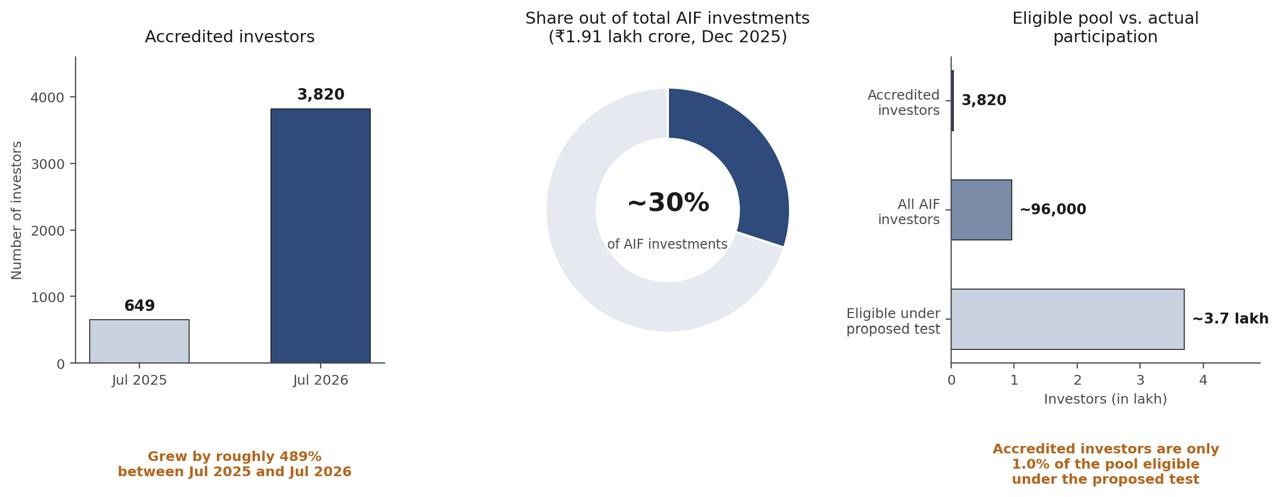
Figures are from SEBI’s August 2026 consultation paper and reflect different reporting dates; the proposed securities-market-exposure test was subsequently adopted in October 2026.
Regulatory Benefits of Accredited Investor Status
Accreditation opens doors across several SEBI-regulated products. In some cases, it lowers the entry threshold; in others, it is the only way in. The recent reforms make that status easier to obtain, without changing every product-specific condition.
The relaxations available across these products are summarized below:[30]
| Product / Structure | Relaxation Available to Accredited Investors |
| AIF (general) | Exemption from ordinary ₹1 crore minimum commitment |
| Specialized Investment Fund (SIF) | No ₹10 lakh minimum ticket size |
| Portfolio Management Services (PMS) | No ₹50 lakh minimum investment; separate relaxation for large-value accredited clients under non-discretionary PMS in relation to unlisted securities |
| Special Situation Funds (SSF) | Minimum ticket size reduced from ₹10 crore to ₹5 crore |
| Angel Funds | Access for accredited investors; QIB treatment for the limited purpose of investing in Angel Funds |
| Co-investment Vehicles (CIV) | Exclusive access to co-invest alongside the main AIF scheme |
| Accredited Investors only funds / LVFs | Exclusive access; LVFs require a ₹25 crore minimum commitment, with specified regulatory relaxations |
The Road Ahead: Wider Access, Greater Responsibility
Five years on, the accredited investor framework has evolved into an important gateway through which investors access India’s private capital markets, from LVFs and angel funds to co-investment vehicles and special situation funds. It is against this backdrop that SEBI, through the October 2026 amendments and the circular dated November 5, 2026, has sought to widen the accredited investor base by simplifying accreditation, expanding eligibility criteria and allowing eligible Managers to determine accredited status directly.
The extension of deemed accredited status to Persons Resident Outside India is particularly significant, as it removes the need for such investors to undergo a separate accreditation process. This relaxation could facilitate greater participation by overseas investors in India’s alternative investment market and encourage the flow of foreign private capital, subject to applicable regulatory requirements. Together with the recognition of securities market exposure as an independent eligibility criterion, these changes also provide an opportunity to tap into the substantial pool of investors who possess the requisite financial capacity but have not yet obtained accredited status.
These measures seek to address the imbalance between the substantial capital represented by accredited investors and the comparatively small number who hold that status, while preserving the regulatory safeguards associated with accreditation. Whether this objective is realised will depend not merely on the relaxations introduced, but also on how effectively Managers discharge their responsibilities in verifying eligibility, managing conflicts of interest and ensuring that greater accessibility does not come at the cost of investor protection.
[1] AIF Regulations, reg. 2(1)(ab), inserted by the SEBI (Alternative Investment Funds) (Third Amendment) Regulations, 2021 (w.e.f. August 3, 2021), and amended by the Third Amendment Regulations, 2026 (notified October 15, 2026).
[2] AIF Regulations, reg. 2(1)(aa); SEBI Circular, Review of the Framework for Accredited Investors, November 5, 2026 (“November Circular”), paras 3.1 and 3.5.
[3] AIF Regulations, reg. 2(1)(ab)(i)–(v), as amended by the Third Amendment Regulations, 2026.
[4] AIF Regulations, reg. 2(1)(ab)(i)–(v); November Circular, paras 5.1, 7.1 and 8.1–8.2.
[5] AIF Regulations, reg. 2(1)(ab), proviso, as amended in October 2026; November Circular, paras 9.1–9.3.
[6] SEBI Master Circular for Alternative Investment Funds dated June 3, 2026 (“Master Circular”), para 10.5.1 (as updated); AIF Regulations, reg. 2(1)(ab).
[7] AIF Regulations, reg. 2(1)(ab); November Circular, paras 3.1–3.5.
[8] AIF Regulations, regs. 10(c), 10(f), 17A(4), 19A(2) and 2(1)(pa); SEBI Circular, Relaxation in Timeline with Respect to Accredited Investor Mandate for Angel Funds, September 7, 2026, para 5.
[9] AIF Regulations, reg. 2(1)(ab), inserted in 2021; SEBI, Consultation Paper on Review of Accredited Investor Framework, August 13, 2026 (“Consultation Paper”), para 3.1.
[10] AIF Regulations, reg. 10(c), proviso (minimum investment threshold not applicable to accredited investors, inserted w.e.f. 03-08-2021); reg. 2(1)(pa) (definition of “large value fund for accredited investors”, inserted w.e.f. 03-08-2021, originally prescribing a minimum investment of seventy crore rupees).
[11] AIF Regulations, reg. 17A, inserted by the Securities and Exchange Board of India (Alternative Investment Funds) (Second Amendment) Regulations, 2025, w.e.f. 09-09-2025; reg. 17A(4) (only accredited investors of the Category I or Category II AIF are eligible to invest in a co-investment scheme).
[12] AIF Regulations, reg. 19A(2), footnote recording the definition prior to its substitution by the Second Amendment Regulations, 2025, w.e.f. 09-09-2025.
[13] AIF Regulations, reg. 19A(2), as substituted w.e.f. 09-09-2025 (“angel investor” means an accredited investor, or key management personnel of an angel fund or its manager, who invests in an angel fund).
[14] AIF Regulations, reg. 19D(1) and (3) (as substituted/renumbered w.e.f. 09-09-2025), reg. 19D(6) (on-boarding of at least five accredited investors before first close) and reg. 19F(5) (each investee company investment to have contribution from at least two accredited investors).
[15] SEBI Circular, Relaxation in Timeline with Respect to Accredited Investor Mandate for Angel Funds, September 7, 2026, para 5 (amending para 8.1.2 of the Master Circular).
[16] AIF Regulations, reg. 2(1)(pa), footnote recording substitution of the LVF minimum investment from seventy crore rupees to twenty-five crore rupees by the Third Amendment Regulations, 2025, w.e.f. 19-11-2025; reg. 2(1)(ac) (definition of “Accredited Investors only fund”, inserted w.e.f. 19-11-2025); reg. 10(f), proviso (accredited investors excluded from the 1,000-investor cap, inserted w.e.f. 19-11-2025).
[17] AIF Regulations, reg. 19D(4), as amended w.e.f. July 14, 2026; reg. 12(2), proviso, as amended by the Second Amendment Regulations, 2026; Master Circular, para 2.5.1.
[18] AIF Regulations, as amended by the Second Amendment Regulations, 2025 (w.e.f. 09-09-2025), the Third Amendment Regulations, 2025 (w.e.f. 19-11-2025), and the Second Amendment Regulations, 2026 (w.e.f. 14-07-2026); Master Circular, Chapter 6.
[19] SEBI, Consultation Paper on Review of Accredited Investor Framework, August 13, 2026; SEBI (Alternative Investment Funds) (Third Amendment) Regulations, 2026, Gazette notification dated October 9, 2026 (published October 15, 2026); November Circular, paras 1–2 and 10.1.
[20] AIF Regulations, reg. 2(1)(ab); November Circular, paras 3.1–3.5.
[21] November Circular, paras 4.1–4.5 and 3.5.
[22] AIF Regulations, reg. 2(1)(ab)(i)–(iv); November Circular, paras 5.1–5.4 and 7.1.
[23] AIF Regulations, reg. 2(1)(ab)(ii), proviso; November Circular, paras 8.1–8.2 and 9.1–9.3.
[24] November Circular, paras 6.1–6.5.
[25] Consultation Paper, proposal concerning wholly owned subsidiaries (paras 6.3.4–6.3.6); compare AIF Regulations, reg. 2(1)(ab), as amended October 15, 2026.
[26] Consultation Paper, para 3.7.
[27] Consultation Paper, para 3.7.
[28] Knight Frank, The Wealth Report 2026, wealth-sizing data for India; see also Knight Frank India, “Knight Frank launches a Private Office in India” (May 2026), https://www.knightfrank.co.in/newsroom/press-releases/2026/5/knight-frank-launches-a-private-office-in-india.
[29] Consultation Paper, paras 5.18–5.19.
[30] Consultation Paper, paras 3.6.1–3.6.6; AIF Regulations, regs. 10(c), 19D(1), 2(1)(ac) and 2(1)(pa); SEBI circular dated September 7, 2026, para 5.