
From Smokestacks to Carbon Sinks: How Carbon Capture Is Shaping India
For over a century, progress has carried a familiar silhouette: towering smokestacks, humming factories, and expanding industrial skylines. Since the Industrial Revolution, carbon emissions have been the invisible thread woven into the fabric of modern economies.
As the window for future emission narrows, India faces a deeper challenge: How to decarbonize an economy that is still growing, expanding its industrial base and lifting millions of livelihoods?
The path ahead is not about replacing one engine with another, it is about redesigning the entire system. Renewable power cuts the carbon at the source, efficiency trims the excess, electrification modernizes demand, and carbon capture steps where chemistry refuses to cooperate. Together, they open a different possibility: a future that eases the burden on the planet while preserving the economic growth and industrial resilience.
Where Clean Energy Reaches Its Limits
While renewable energy is transforming the power grid, some industries cannot escape their carbon footprint like cement, steel, fertilizers, and chemicals produce CO₂ not just from burning fuel; it comes directly from the chemical reactions that produce the materials. For instance, in cement manufacturing, carbon dioxide is released during the conversion of limestone into clinker, a reaction that occurs regardless of whether the plant is powered by solar energy or coal. Similarly, in steelmaking and fertilizer production, emissions arise directly from core production chemistry. These are classified as hard-to-abate emissions, as they persist even under the most optimistic clean-energy scenarios.
The gap between what can be reduced and what inevitably remains is precisely where carbon capture plays a vital role. Recognizing this, the Union Budget 2026-27 has allocated a ₹20,000 crore to scale CCUS technologies. This fiscal support acts as a strategic shield; with international mechanisms like the EU’s Carbon Border Adjustment Mechanism (CBAM) entering enforcement phase, CCUS provides Indian exporters a lifeline to reduce their carbon footprint and avoid heavy international taxes.
Beyond Renewables: What is CCUS?
While solar and wind are replacing fossil fuels in our power grids, they cannot reach inside a furnace or a chemical reactor. This is where Carbon Capture, Utilization, and Storage (CCUS) comes in. Think of it as an industrial filter that strips CO₂ from exhaust before it reaches the atmosphere.
The process follows a three-stage value chain:
- Capture: CO2 is separated from other gases produced at industrial facilities (like steel plants or refineries) using chemical solvents or specialized membranes.
- Compression & Transport: The captured gas is compressed and transported via pipelines or ships.
- Utilization or Storage: The carbon is either recycled into products like synthetic fuels and “green” concrete (Utilization) or injected deep underground into saline aquifers for permanent isolation (Storage).
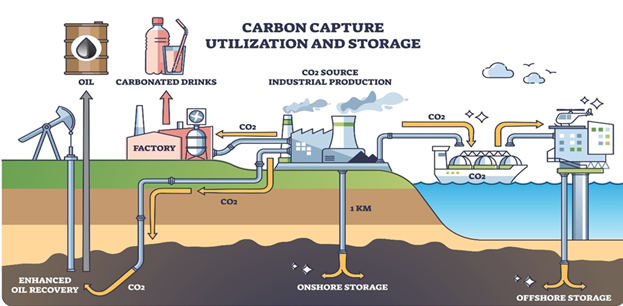
Image: CCUS process (Source: Shutterstock)
The global economy is moving toward a future where carbon carries a cost, whether explicit or embedded. The European Union’s Carbon Border Adjustment Mechanism is reshaping how emissions are measured and monetized across borders. In this emerging landscape, emissions are no longer only an environmental concern; they are a financial liability.
Carbon capture enables industries to reduce embedded emissions, strengthen disclosure credibility, and build resilience against carbon-linked trade barriers.
Why Carbon Capture Matters for India’s Growth Trajectory and Its Industries
India’s climate strategy balances ambition with pragmatism, aiming to reduce emissions intensity while steadily moving toward net zero by 2070. For industries like cement, steel, power, and refining, CCUS offers a practical pathway to decarbonize. By capturing emissions directly from production processes, industries can gradually lower their carbon footprint while maintaining operational continuity.
Beyond operational benefits, CCUS positions Indian industries to meet increasingly stringent global climate standards. With mechanisms like the European Union’s Carbon Border Adjustment, emissions are becoming a measurable cost of doing business internationally. Adopting CCUS helps companies maintain access to global markets, comply with carbon-related trade rules, and enhance their reputation as environmentally responsible businesses.
CCUS integration requires strategic planning, assessing technical feasibility, allocating resources for infrastructure, and aligning operations with reporting standards such as BRSR, CDP, ISSB, and CSRD. Beyond emissions reduction, this approach strengthens global market access, supports compliance with evolving carbon regulations, and positions companies to meet international climate benchmarks.
A New Chapter in India’s Climate Story
CCUS is changing the story of India’s industrial landscape. Imagine a cement plant or a steel mill capturing the carbon that would have escaped into the sky and turning it into usable materials or storing it safely underground. Smokestacks, once seen as symbols of pollution, can now be gateways to innovation and sustainability.
By embedding carbon capture into industrial processes, India is bridging the gap between economic growth and climate responsibility. This approach allows industries to continue powering the economy while actively reducing their carbon footprint.